
BLOG
What Everyone Ought To Know About Dog Training (and maybe you should to)
Dogs are a man's best friend for a reason. They're loyal, obedient, and always excited to see us. Yet training our furry best friends can be so confusing. But, we're here to help.
In this post, we'll talk about the three most common methods of training a dog using;
Capturing,
Luring, and
Shaping
Capturing.
Capturing is a type of training in which you reward your dog for exhibiting desirable actions and encourage them to repeat those behaviors.
The most common way to capture behavior is to click a clicker or use a verbal marker (such as the word "yes" or whatever command you want to associate with that captured behavior) when your dog performs the desired behavior you're looking for, you then immediately follow up with a treat or reward.
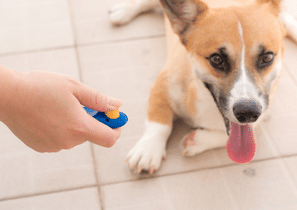
Using a Clicker to capture behavior.
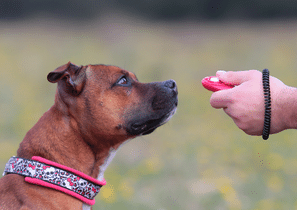
Some of you may believe a clicker is not required to capture the desired action, but it's a wonderful tool for capturing the exact moment that a dog performs the desired behavior that you want, and it has a distinct and piercing sound that can tell the dog exactly what you're attempting to catch at the precise moment.
For example, if you're trying to capture the behavior of your dog sitting, and you click when he's in the process of sitting, he may not understand why he's being rewarded and may get up again. However, if you wait until he's actually in the sitting position before you click, he'll be more likely to understand that it's the sitting behavior you're trying to capture.
Clickers are particularly useful for behaviors that happen quickly or behaviors that your dog may do only occasionally. If you're having trouble getting your dog to perform a certain behavior, you can try luring (explained below) to get him started, and then switch to capturing once he's getting the hang of it.
Luring is often used in conjunction with Capturing (explained below), as it can be used to get your dog started on the behavior you're trying to capture.
Here's a quick overview of how to use Capturing to train your dog:
Decide what behavior you want to capture.
Start paying close attention to your dog whenever he performs that behavior.
As soon as he does it, immediately give him a cue (verbal or otherwise) that he has done something you want, and then give a reward.
Common mistakes people make when training their dogs using Capturing include:
Not being consistent - if you only capture your dog's behavior sometimes, he won't understand what it is you're trying to teach him.
Failing to pay attention - if you're not paying close enough attention to your dog, you might miss the opportunity to capture the behavior when it happens.
Trying to capture too many behaviors at once - it's important to focus on one behavior at a time if you want your dog to learn it effectively.
If you keep these things in mind, capturing can be an extremely effective way to educate your dog on the behavior you desire.
Luring.
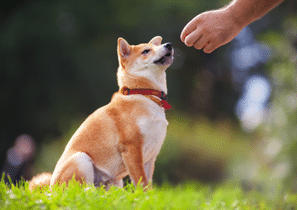
Luring is a method of dog training that involves enticing your dog to perform the desired behavior by holding a treat or toy in front of his nose and moving it in the direction you want him to go.
For example, if you want your dog to sit, you would hold a treat in front of his nose and move it back towards his tail until he sits down. Luring is often used in conjunction with Capturing (explained above), as it can be used to get your dog started on the behavior you're trying to capture.
Here's a quick overview of how to use luring to train your dog:
Decide what behavior you want your dog to perform.
Get a treat or toy that your dog is interestedin and hold it in front of his nose.
Move the treat or toy in the direction you want him to go until he performs the desired behavior.
As soon as he does it, give him the treat or toyand praise him enthusiastically.
Repeat this process until your dog is consistently performing the desired behavior.
Common mistakes using luring as a training method include:
Moving the treat or toy too quickly can confuse or distract the dog.
Not rewarding the dog sufficiently when he performs the desired behavior.
Continuing to give rewards even after the dog has learned thebehavior, which can lead to complacency.
Warning - Luring should not be over-used!
Once your dog has learned the behavior captured by luring, you should start phasing out the rewards. If you continue to use treats or toys as lure rewards after your dog has learned the behavior, he may become fixated on the lure and only perform the behavior when he knows there's a reward involved. This can make it difficult to wean him off the rewards altogether.
This brings us to the final dog training method using positive reinforcement Shaping. Shaping a dog's behavior brings both Capturing and Luring into perspective as tools used in the training of dogs.
Shaping.
Shaping is a training method that involves progressively rewarding your dog for behaviors that are close to the desired behavior, and teaching your dog a sequence of desired behaviors.
For example, if you want your dog to jump up on your couch, you would start by rewarding him for putting his front paws on the couch using either capturing or luring (see above). Once he's consistently doing that, you would only reward him when he puts his back paws on the couch as well.
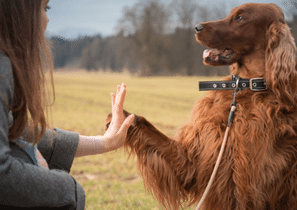
Eventually, with enough repetitions, he will learn that the behavior you are rewarding is jumping up on the couch (not a great and desirable trick, by the way:)).
Shaping is mostly used for more advanced training and tricks. Simple skills such as "sit" and "down" are taught by capturing and luring. Shaping is more about taking training your dog to the next level. Shaping is used in training a dog to perform more complex skills like agility, pole weaving, flyball, leash work, etc. Even professional trainers use shaping to train dogs to herd livestock, police work, guide dog work, and rescue and emergency work. Anything more complex than teaching a simple action requires shaping.
The most essential thing to remember about shaping your dog's new behaviors is that you're teaching him a sequence of actions, some of which he has learned in smaller chunks through catching and luring. Shaping is all about combining the many behavioral stages your dog has learned into a more sophisticated training structure for him to comprehend.
Conclusion.
There is no such thing as the "best," since they may all be utilized in conjunction with one another, or as part of a training sequence. Think of capturing, luring, and shaping as the bridge or communication gap between you and your dog.
Instead of yelling commands to your dog, consider employing capturing, luring, and shaping to elicit what behavior you want. Dogs aren't capable of comprehending language (although many of my friends have fascinating talks with their dogs!). That's why we use capturing, luring, and shaping to communicate with our dogs so that they know exactly what we want them to do!
That's it for this post. I hope you've found it helpful. Happy training!
Follow us on:
OPT-IN FOR OUR FREE
Raw Feeding Infographic

Grab a FREE Copy of the latest FitK9 Raw Feeding Guidelines Infographic. Just enter your email address and click the button below to grab your PDF copy NOW.
OPT-IN TO DOWNLOAD
The ULTIMATE FitK9
Walking for Weight-Loss Checklist
Grab a FREE Copy of the Ultimate FitK9 Walking for Weight Loss Checklist. Just enter your email and click the button below to grab your PDF copy NOW.
Need this [thing]??
PROMOTE YOUR MAIN OFFERS HERE WITH AN AMAZING OFFER.
Sub headline that encourages actions
Copyright © 2022 | FitK9 Pty Ltd ABN 50102362023